

Past Exhibitions

Tracing Foodways through Art
From the Field
From the Field: Tracing Foodways through Art explores the idea of food as not only nourishment but also an expression of our lived and shared experiences. This exhibition invites audiences to reflect on their relationships to foodways, which encompass our attitudes, practices, and rituals around food. Artworks across different time periods, mediums, and cultures illustrate points of connection, disconnection, and reconnection to our foodways.
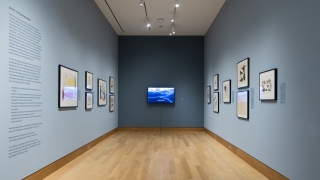
The Jane and Raphael Bernstein Collection
A Legacy for LearningA Legacy for Learning: The Jane and Raphael Bernstein Collection comprises a series of exhibitions that individually and collectively celebrate the Bernstein family's gifts to the collection of the Hood Museum of Art over four decades. These shows present photography, paintings, prints, drawings, and sculpture by European, Japanese, and North American artists.
In spring and summer 2021, the museum features the Bernstein Collection installations Pinpricks and Pomposity: The Inventiveness of English Visual Satire, Landscape(d): Modern Photography and the Environment, and Lyrical Journey: Toko Shinoda.
In August 2021, the installations change over to Inuit Art | Inuit Qaujimajatuqangit, Both Sides of the Lens: Portrait Photography, and Mystic Peak: Selections from the Bernstein Collection of Japanese Art, through January 2022.

Myth, Cult, and Daily Life
Poseidon and the Sea
The realm of Poseidon encompassed virtually every aspect of life in the ancient Mediterranean world, from mythology and cult to daily activities. This exhibition explores each of his dominions through more than one hundred works of Greek, Etruscan, and Roman art produced between 800 BCE and 400 CE. Visitors will see striking black-figure and red-figure pottery, alongside sculptures in terracotta, marble, and precious metals, and extraordinary examples of ancient glass, mosaics, carved gems, and coins, all providing a rich picture of life in the ancient world. Poseidon and the Sea offers an intimate look not only at the mysteries of the ancient world, but also at the timeless beauty and wonder of the sea that continues to resonate with us in the present day.
Selections from the Hood Museum of Art
The Beauty of BronzeBronze—a combination of copper, tin, and small amounts of other metals—has long been prized for its preciousness, endurance, and ability to register fine details and reflect light. It is strong and durable, making it ideal for modeling expressive gestures, yet—in molten form—it is malleable enough to be suitable for creating intricate shapes. The term “bronze” is often used for other metals as well, including brass, which is an alloy of copper and zinc.
There are two basic methods of casting a bronze in order to make multiple versions of the same design. Sand casting—developed in the early nineteenth century in Europe—is a relatively simple and less expensive technique that relies upon disparate molds made of compacted fine-grained sand that allow for easy production and assembly. Traditional lost-wax casting uses wax models in two manners, or methods, both of which date from antiquity. In the “direct” method, the original wax model itself is used (and thereby destroyed); in the “indirect” method, reusable plaster molds are taken from the original wax model.
The medium’s intrinsic tensile strength and ability to render precise features and various surfaces have been applied to a variety of objects, including vessels, implements, portraits, animals, and figurines. The examples on display here document the worldwide attraction to this remarkable material from antiquity to the early twentieth century.
Manifestations of Inequality
Objects and PowerThe world today is an unequal place where individuals face stark differences in their access to resources, information, and power. The archaeological record suggests that such inequities have existed in various cultures throughout human history. This student-curated installation considers some of the challenges of interpreting and presenting material objects as they relate to inequality. Just as professional archaeologists have built their theories using both ancient artifacts and cultural materials from contemporary populations, the student curators have assembled a diverse collection to consider four domains in which archaeologists can see inequality created, reproduced, and challenged in ancient societies. The central themes—craft goods, daily life, public performance, and mortuary practice—offer interwoven views on the intersecting lives of people and the material objects that they use to communicate status among their families and to other members of society. The objects on display serve as metaphors for understanding the dynamics underlying how different cultures have invented and shaped inequality in its many forms.
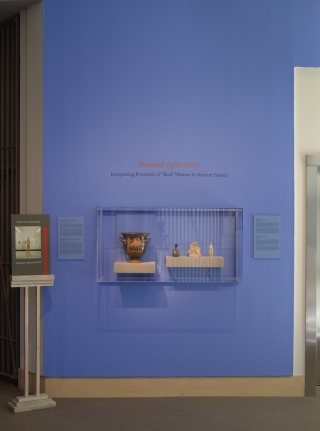
Interpreting Portrayals of "Real" Women in Ancient Greece
Beyond Aphrodite
Many aspects of the lives of ancient Greek women remain a mystery to us today. While surviving literary sources and artifacts often feature powerful female goddesses, images and texts describing the lives of everyday, or "real," Greek women are more difficult to identify and understand. This exhibition presents three objects that depict those women.