
Past Exhibitions
The Intersections between Black and White
Abstracting Emotion
In Western culture, the color black is a code or symbol sometimes associated with depression, darkness, and despair. Some twentieth-century artists have gone beyond these preconceptions to imbue the color with very personal associations by manipulating the cultural significance of black using the principles of abstraction. The artists harness a range of tones, forms, lines, and edges to create a unique style and form of expression centered upon black.
Artists' Intentions and the Meaning of the Stars and Stripes
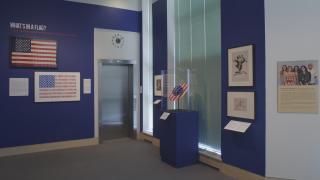
What's in a Flag?
The six artists featured in this installation use the flag to make a wide range of points, from a scathing indictment of American foreign policy to a commentary on the paranoia and insecurity of the American middle class. Some of them, intentionally or not, challenge viewers' presumptions about such a recognizable symbol. With introspection and additional information, the viewer can come closer to understanding the artists' intention and the flags' meanings. The more aware we are of the possibilities, the richer our experience of these works will be.
Interpreting Portrayals of "Real" Women in Ancient Greece
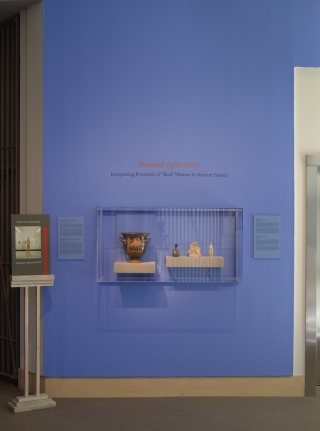
Beyond Aphrodite
Many aspects of the lives of ancient Greek women remain a mystery to us today. While surviving literary sources and artifacts often feature powerful female goddesses, images and texts describing the lives of everyday, or "real," Greek women are more difficult to identify and understand. This exhibition presents three objects that depict those women.
Modern Melancholy
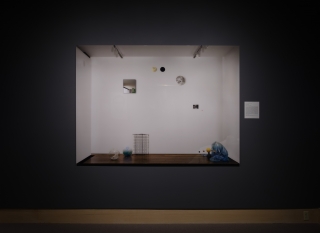
The artists selected for this exhibition express the melancholic condition within a contemporary context and raise questions about what distinguishes melancholy today. In a society of constant sensory stimulation, instant gratification, and hedonistic saturation, have happiness and satisfaction become an obligation? Have we attained the object of our desire but lost the reason for its desirability? Through their deliberate interpretations of melancholic subjects and settings, the artists in this exhibition realize the vitality that emerges as the melancholic sees opportunities everywhere to mourn this lost desire. In fact, melancholy's redemption lies precisely within those infinitely unfolding creative and intellectual possibilities that it reveals.
Narratives of African American History and Identity
Text as Image/Image as Text
The written narrative is the most valued form of knowledge production throughout modern Western history. This has significant implications for, among others, African American slaves, who were systematically denied participation in written discourse. It is not only a question of who has written history, but more importantly, who can? And how? With this background as a rich framework for critique, text as image has in turn become a powerful tool for artists interested in illuminating the dominant ways of manufacturing narratives and claiming knowledge.
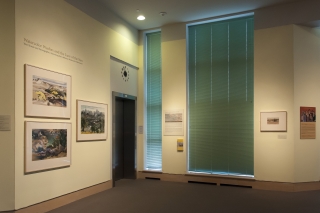
The Climate and Demographics Informing the California Watercolor
Watercolor Washes and the Lure of the Sun
From the 1930s to the 1960s, a group of watercolorists based in Southern California responded to the region's distinctive environment by creating primarily large, colorful watercolors of the local scene, painted on the spot outdoors. These generally upbeat, optimistic images celebrated the Edenic California landscape, despite the dramatic demographic and economic forces that were already altering both the physical characteristics and social mosaic there.